Loading image …
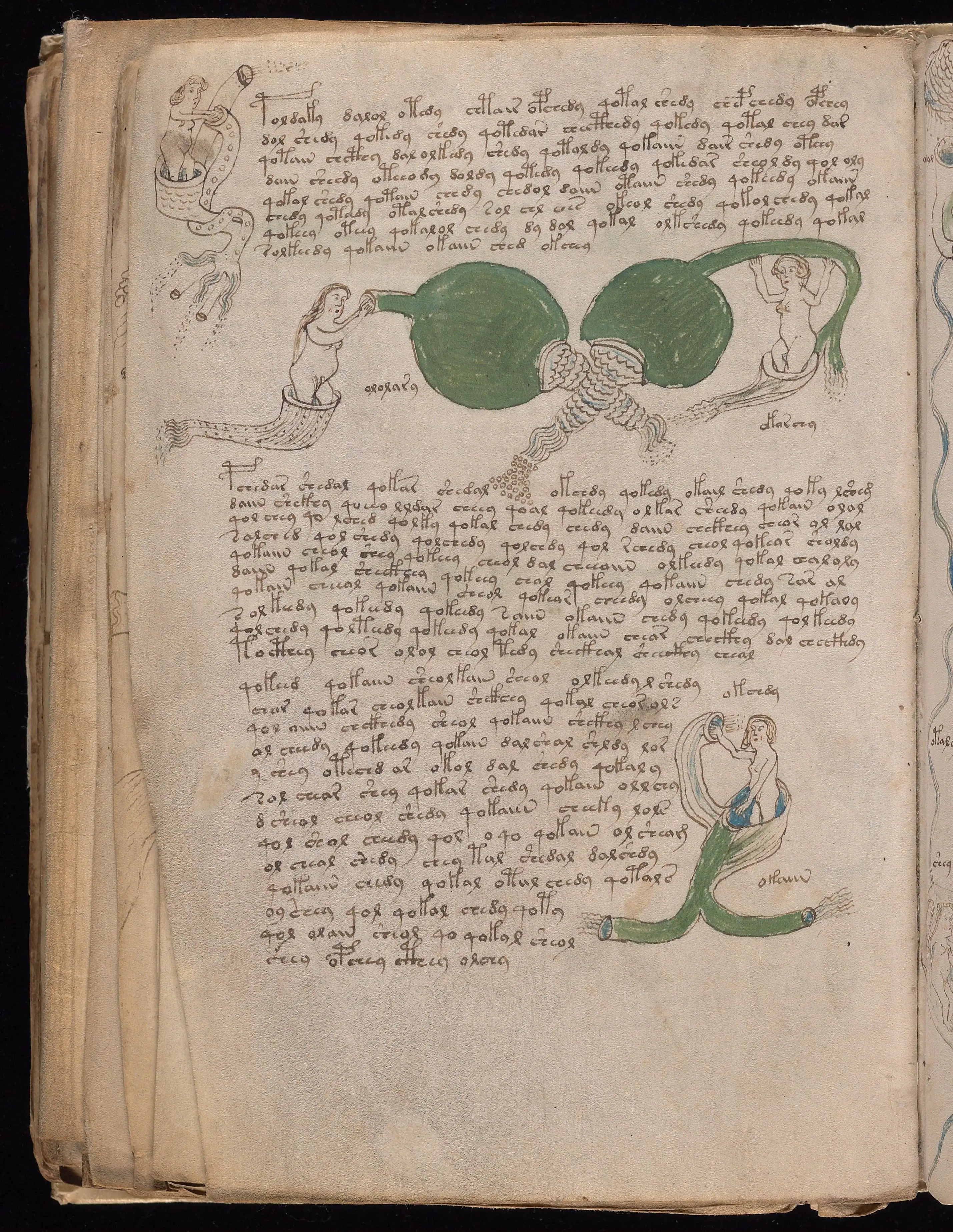
Base data
- Register type
- —
- Language class
- —
- Scribe hand
- —
Transcribers
- Sigla
- H · V P1.1–Y.8 (all paragraphs), n=2 — diverging: doiin, ches, rolkeedy, pchedas, shedasF P1.1/P1.2/P1.3/P1.4/P1.5/P1.6/P1.7/P1.8/P2.9/P2.10/P2.11/P2.12/P2.13/P2.14/P2.15/P2.16/P2.17/P2.18/P2.19/P2.20/P2.21/P2.22/P2.23/P2.24/P2.25/P2.26/P2.27/P2.28/P2.29/P2.30/P2.31/Y.8 (32 of 35) — diverging: qotaiin, otchy, qotedy, s, lshemC P1.1/P1.2/P1.3/P1.4/P1.5/P1.6/P1.7/P1.8/P2.9/P2.10/P2.11/P2.12/P2.13/P2.14/P2.15/P2.16/P2.17/P2.18/P2.19/P2.20/P2.21/P2.22/P2.23/P2.24/P2.25/P2.26/P2.27/P2.28/P2.29/P2.30/P2.31 (31 of 35) — diverging: q, tal, chedy, dalolkedy, daldyU X.5/X.6/Y.7/Y.8 (4 of 35)
Rules
R1
qo- = וְ (Vav conjunctive) — ausschließlich Sprache B in Quires A+B 87 von 265 Token qo-initial (z. B. qotal, qokedy, qotedar, qotain)
R2 o-Positionsdetermination ^o: 43 Token (z. B. otedy, opchedy, opchey); o wortintern: 124 Token (z. B. poldaky, dalol, qotal)
R6 Zeilenabschluss-Prognose: sheol/shol = Tod; or = Heilung Todesprognose zeilenfinal: sheol P2.30
R7 daiin am Zeilenanfang = Paragraphen-Öffner 2× daiin am Zeilenanfang (P2.10, P2.14)
R8 -aiin als Suffix = עַיִן (Auge) diagnostisch -aiin=עַיִן: 16× (z. B. okaiin, qokaiin, qotaiin, otaiin)
R9 Refrain-Wörter — Anker-Position (≥3× pro Folio) qol — 4× Anker (4 Öffner, 0 Kolophon), 9× gesamt
R11 Paragraphen-Ende mit = = Abschlussformel P1.8: okchey= (3/4); X.5: ololary= (3/3); X.6: okarchy= (3/3); P2.18: cheal= (2/4); P2.31: olchy= (3/4); Y.7: okaiin= (2/3); Y.8: okchdy= (3/4)
R15 Paradigma-Wiederholungsreihen (×2–×5) P1.2: shedy·qokedy·shedy (Typ B); P1.2: qokedy·shedy·qotedar·checthedy·qokedy (Typ B); P1.3: shedy·qotaldy·qokaiin·dair·shedy (Typ B); P1.5: shedy·qotain·chedy·chedol·daiin·otaiin·shedy (Typ B); P1.7: qokal·olkshedy·qokeedy·qokal (Typ B); P2.9: shedal·qokar·shedal (Typ B); P2.11: chedy·chedy (Typ A); P2.12: qol·shedy·qolchedy·qolchdy·qol (Typ B); P2.13: cheol·shey·qokeey·cheol (Typ B); P2.14: qokeey·chal·qokeey (Typ B); P2.15: qokaiin·qokaiin (Typ A); P2.15: qokal·qokaoy·qokal (Typ B); P2.15: qokaoy·qokal·qokaoy (Typ B); P2.16: qokeedy·qokeedy (Typ A); P2.16: qokeedy·saiin·okaiin·chedy·qokeedy (Typ B); P2.21: chey·chey (Typ A); P2.26: qol·shol·cheedy·qol (Typ B); P2.28: chedy·qokal·otal·chedy (Typ B); P2.30: sheol·qo·qokal·sheol (Typ B)
R17 shol (apokor.) medial vs. sheol (Vollform) am Zeilenende shol medial 1×, sheol final 1×, sheol medial 3×
R19 Intensivierungsrhetorik P2.11: chedy·chedy (×2); P2.15: qokaiin·qokaiin (×2); P2.15: qokal·qokaoy·qokal·qokaoy (ABAB); P2.16: qokeedy·qokeedy (×2); P2.21: chey·chey (×2)
R20 Direktionales Antonymenpaar lor ↔ lshol P2.22: lor (4/4)
R37 R19-Intensivierungsschema für qo--Präfix-Wortgruppen ab Quire C P2.9: qoky (3/4); P1.4: qotedy (4/4)
R40 Kurzwurzel-Konfidenzdeckel v2 P2.14: sar (3/4); P2.19: sheol (4/4); P2.21: sheol (3/4); P2.30: sheol (4/4); P1.5: daiin (3/4); P2.10: daiin (4/4); P2.11: daiin (4/4); P2.14: daiin (3/4); P1.3: dal (3/4); P2.13: dal (3/4); P2.17: dal (4/4); P2.23: dal (4/4)
R41 Präfix-Hierarchie-Protokoll 25× korrekt geschichtete Präfixkette (qokeedy (qo-k-), qokal (qo-k-), qokeedy (qo-k-), qokal (qo-k-) …); VERLETZUNG: X.5: ololary (ol-ol-, Grund b); P2.10: lldar (l-l-, Grund b); P2.24: ollchy (ol-l-, Grund b); P2.25: lols (l-o-, Grund a)
R50 Galiläische Guttural-Abschwächung — Sprache-B-Vokalklärung P2.15: cheedy (4/4); P2.22: cheedy (3/4); P2.26: cheedy (4/4); P1.4: qokeedy (4/4); P1.5: qokeedy (4/4); P1.7: qokeedy (4/4); P2.10: qokeedy (4/4); P2.16: qokeedy (3/4); P2.17: qokeedy (4/4); P2.22: qokeedy (3/4); P1.4: sheedy (4/4); P2.10: sheedy (4/4)
R59 qo als isolierter Konnektiv-Token P2.11: qo (4/4); P2.30: qo (4/4)