Loading image …
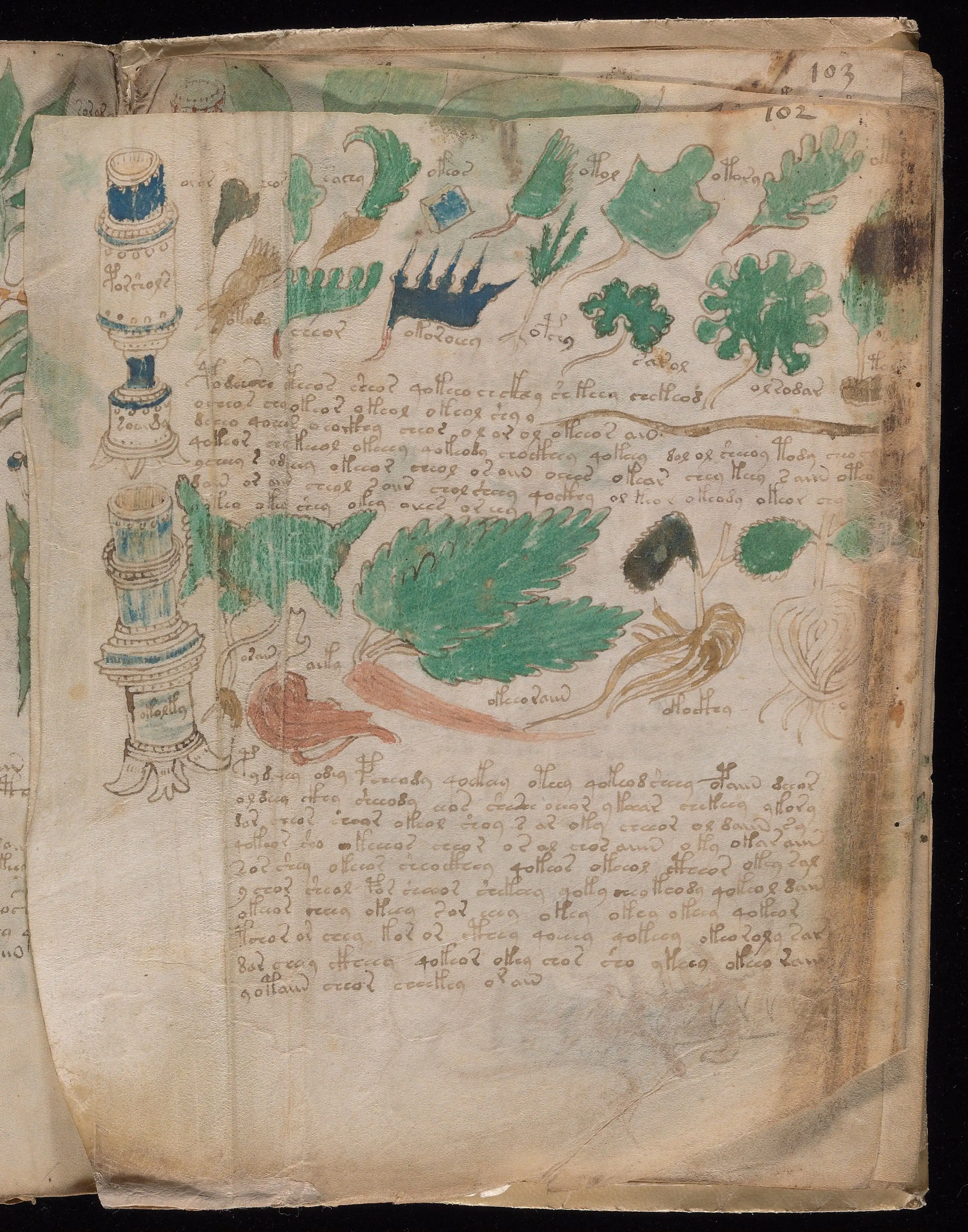
Base data
- Register type
- —
- Language class
- —
- Scribe hand
- —
Transcribers
- Sigla
- H · U C.1–P2.18 (all paragraphs), n=2 — diverging: oteeos, chckhhy, chy, okeor, shyV C.1/C.2/C.3/L1.1/L1.2/L1.3/L1.4/L1.5/L1.6/L1.7/L2.1/L2.2/L2.3/L2.4/L2.5/L2.6/L2.7/L3.1/L3.2/L3.3/L3.4/L3.5 (22 of 39) — diverging: okolky, orar, chor, oteos, otF L2.6/P1.1/P1.3/P1.4/P1.5/P1.6/P1.7/P1.8/P2.9/P2.10/P2.11/P2.12/P2.13/P2.14/P2.15/P2.16/P2.17/P2.18 (18 of 39) — diverging: podeecho, sheor, decho, okeeo, saiin
Rules
R1
qo- = וְ (Vav conjunctive) — ausschließlich Sprache B in Quires A+B 16 von 184 Token qo-initial (z. B. qokeeo, qoeeor, qokeor, qokeody)
R2 o-Positionsdetermination ^o: 64 Token (z. B. otolky, oror, okeos); o wortintern: 95 Token (z. B. porshols, soe, otolky)
R3 y-initiale Wörter = Imperfekt 3. Sg. Mask. P1.6: ycheey (3/3)
R4 t-initiale Wörter = Imperfekt 3. Sg. Fem. / 2. Sg. P2.16: tchor (3/3)
R9 Refrain-Wörter — Anker-Position (≥3× pro Folio) qokeor — 3× Anker (2 Öffner, 1 Kolophon), 4× gesamt
R11 Paragraphen-Ende mit = = Abschlussformel C.2: dy= (2/3); C.3: otolky= (2/3); L1.1: oror= (2/3); L1.2: eeor= (2/3); L1.3: sachy= (3/3); L1.4: okeos= (1/3); L1.5: otol= (3/3); L1.6: otory= (3/3); L1.7: ok= (1/3); L2.1: okody= (2/3); L2.2: cheor= (3/3); L2.3: okoroeey= (3/3); L2.4: opchy= (3/3); L2.5: sarol= (3/3); L2.6: olrodar= (4/4); P1.8: oreey= (1/3); L3.1: oran= (1/3); L3.2: oika= (1/3); L3.3: okeeoraiin= (3/3); L3.4: okockhy= (3/3); L3.5: eddy= (1/3); P2.15: qokeor= (2/3); P2.18: orain= (2/3)
R15 Paradigma-Wiederholungsreihen (×2–×5) P1.3: okeol·okeol (Typ A); P1.4: ol·or·ol (Typ B); P1.6: aiin·okear·okear·chey·keey·s·aiin (Typ B); P1.6: okear·okear (Typ A); P2.9: opaiin·deeor·opaiin (Typ B); P2.15: okeey·sar·chey·okey·okey·okeey (Typ B); P2.15: okey·okey (Typ A); P2.16: or·chey·kor·or (Typ B)
R19 Intensivierungsrhetorik P1.3: okeol·okeol (×2); P1.6: okear·okear (×2); P2.15: okey·okey (×2)
R31 Temperatur-Antonymenpaar kor ↔ kchom — hippokratisches Diagnostikschema P2.16: kor (3/3)
R37 R19-Intensivierungsschema für qo--Präfix-Wortgruppen ab Quire C P2.14: qoky (3/3)
R38 {plant}-Marker am Paragraphenanfang — neue Strukturvariante in Quire C {plant}-Marker am Paragraphenanfang (Quire B)
R40 Kurzwurzel-Konfidenzdeckel v2 P2.16: sar (3/3); P2.11: daiin (3/3); P1.4: or (3/3); P1.7: or (3/3); P2.16: or (3/3)
R41 Präfix-Hierarchie-Protokoll 5× korrekt geschichtete Präfixkette (otolky (o-ol-), okeeor (o-k-), okeeor (o-k-), okeeor (o-k-) …)