Loading image …
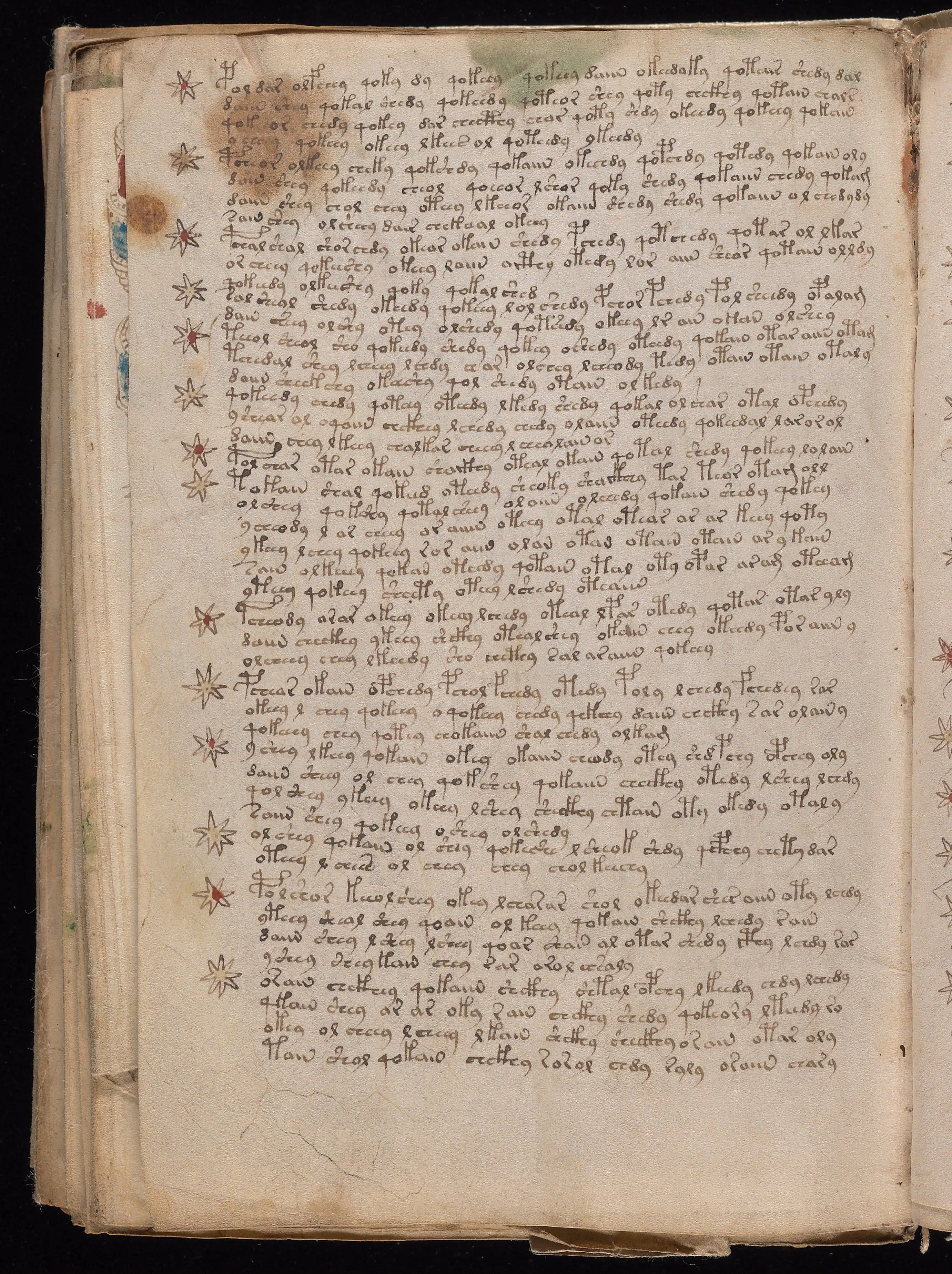
Base data
- Register type
- —
- Language class
- —
- Scribe hand
- —
Transcribers
- Sigla
- F · H P.1–P.44 (all paragraphs), n=2 — diverging: pal, qotaiin, char, qot, qokaiinU P.25/P.26/P.27/P.28/P.28a/P.36/P.36a (7 of 46) — diverging: akeey, okeey, lchedy, otar, ylyJ P.1/P.2/P.3/P.4/P.5/P.6 (6 of 46) — diverging: olpchey, qotaiin, char, qokaiin, ycheey
Rules
R1
qo- = וְ (Vav conjunctive) — ausschließlich Sprache B in Quires A+B 74 von 453 Token qo-initial (z. B. qoky, qokeey, qotear, qokal)
R2 o-Positionsdetermination ^o: 125 Token (z. B. olfchey, okeedaky, or); o wortintern: 121 Token (z. B. pol, qoky, qokeey)
R3 y-initiale Wörter = Imperfekt 3. Sg. Mask. P.32: yshey (2/2); P.40: yshey (2/2)
R4 t-initiale Wörter = Imperfekt 3. Sg. Fem. / 2. Sg. P.21: teor (2/2)
R6 Zeilenabschluss-Prognose: sheol/shol = Tod; or = Heilung Heilungsprognose zeilenfinal: or P.19=
R7 daiin am Zeilenanfang = Paragraphen-Öffner 6× daiin am Zeilenanfang (P.2, P.7, P.19, P.28, P.33, P.39)
R8 -aiin als Suffix = עַיִן (Auge) diagnostisch -aiin=עַיִן: 11× (z. B. okaiin, olaiin, qokaiin, oraiin)
R9 Refrain-Wörter — Anker-Position (≥3× pro Folio) daiin — 6× Anker (6 Öffner, 0 Kolophon), 8× gesamt; olshey — 3× Anker (2 Öffner, 1 Kolophon), 3× gesamt
R11 Paragraphen-Ende mit = = Abschlussformel P.4: ykeedy= (1/3); P.8: okeey= (1/2); P.11: shed= (1/2); P.13: olshey= (1/2); P.16: olkedy= (1/2); P.19: or= (1/2); P.26: oteaiin= (3/3); P.28a: qokeey= (2/3); P.31: olkam= (2/2); P.35: olshedy= (2/2); P.36a: keechy= (3/3); P.40: chsaly= (1/2); P.44: chary= (1/2)
R15 Paradigma-Wiederholungsreihen (×2–×5) P.1: qokeey·qokeey (Typ A); P.5: qokaiin·okechdy·qopchdy·qotedy·qokaiin (Typ B); P.7: shedy·shedy (Typ A); P.12: shedy·okeedy·qokeey·lol·shedy (Typ B); P.15: otain·otain (Typ A); P.20: okain·shaikhy·oteal·okain (Typ B); P.23: ar·ar (Typ A); P.24: otain·otain (Typ A); P.25: oteedy·oteedy (Typ A); P.36a: chey·chey (Typ A); P.39: lshey·lshey (Typ A); P.42: ar·ar (Typ A)
R17 shol (apokor.) medial vs. sheol (Vollform) am Zeilenende shol medial 2×, sheol medial 1×
R19 Intensivierungsrhetorik P.1: qokeey·qokeey (×2); P.7: shedy·shedy (×2); P.15: otain·otain (×2); P.23: ar·ar (×2); P.24: otain·otain (×2); P.25: oteedy·oteedy (×2); P.36a: chey·chey (×2); P.39: lshey·lshey (×2); P.42: ar·ar (×2)
R20 Direktionales Antonymenpaar lor ↔ lshol P.10: lor (2/2)
R37 R19-Intensivierungsschema für qo--Präfix-Wortgruppen ab Quire C P.1: qoky (3/3); P.6: qoky (3/3); P.11: qoky (2/2); P.5: qotedy (3/3)
R40 Kurzwurzel-Konfidenzdeckel v2 P.30: sar (2/2); P.14: sheol (2/2); P.1: daiin (3/3); P.2: daiin (3/3); P.7: daiin (2/2); P.19: daiin (2/2); P.28: daiin (3/3); P.30: daiin (2/2); P.33: daiin (2/2); P.39: daiin (2/2); P.1: dal (3/3); P.3: or (2/3); P.10: or (2/2); P.19: or (2/2)
R41 Präfix-Hierarchie-Protokoll 14× korrekt geschichtete Präfixkette (qokal (qo-k-), qokeedy (qo-k-), okeedy (o-k-), qokshdy (qo-k-) …); VERLETZUNG: P.10: olldy (ol-l-, Grund b); P.20: lolain (l-ol-, Grund b)
R50 Galiläische Guttural-Abschwächung — Sprache-B-Vokalklärung P.2: qokeedy (3/3); P.6: qokeedy (3/3); P.11: qokeedy (2/2); P.14: qokeedy (2/2); P.17: qokeedy (2/2); P.12: sheedy (2/2); P.4: qoteedy (3/3)