Loading image …
Base data
- Register type
- Declarative
- Language class
- Currier A
- Scribe hand
- 1
Codicology
- Page
- AA (Rene) · p001 (Stolfi)
- Leaf
- f1
- Panels
- f1r
- Bifolio
- bA1 = f1 + f8 →
- Quire
- A (Rene) · I (Beinecke)
- Subsets
- T (Rene) · unk (Stolfi)
- Subject
- unknown (text only)
- Colors
- red (Reeds)
Transcribers
- Sigla
- C · F · H · N · U P1.1/P1.2/P1.3/P1.4/P1.5/T1.6/P2.7/P2.8/P2.9/T2.10/P3.11/P3.12/P3.13/P3.14/P3.15/P3.16/P3.17/P3.18/P3.19/P3.20/T3.21/P4.22/P4.23/P4.24/P4.25/P4.26/P4.27/T4.28 (28 of 53): diverging: cthorys, o, r, kain, shtaiinJ L.1/L.2/L.3/L.4/L.5/L.6/L.7/L.8/L.9/L.11/L.12/L.13/L.14/L.15/L.16/L.17/L.18/L.19/L.20/L.21/L.22/W.23/X.24/Y.25/Z.26 (25 of 53)X P1.5/T1.6/P2.9/T2.10/P3.20/T3.21/P4.27/T4.28 (8 of 53): diverging: ydar, aish, y, sh, ckhoyD P1.4 (1 of 53): diverging: oiin, oteor, soloty, ol
Rules
R1
qo- = וְ (Vav conjunctive), nur Sprache B in Quires A+B 0 qo-Token in 214 Token (Spr. A): Negativbeleg Full rule →
R2 o-Positionsdetermination ^o: 30 Token (z. B. or, ooiin, oteey); o wortintern: 87 Token (z. B. shol, shory, kor) Full rule →
R3 y-initiale Wörter = Imperfekt 3. Sg. Mask. P1.1: ykal (5/5); P1.3: ykaiin (5/5); P2.8: yshey (4/5); P3.17: ycho (5/5); P3.18: yto (5/5); P4.25: ycheey (4/5); P3.11: ydain (5/5) Full rule →
R4 R7 R8 -aiin als Suffix = עַיִן (Auge) diagnostisch -aiin=עַיִן: 8× (z. B. cthaiin, kaiin, oiin, okaiin) Full rule →
R11 Paragraphen-Ende mit = = Abschlussformel P1.5: cfhaiin= (5/6); T1.6: ydaraishy= (5/6); P2.9: shody= (4/6); T2.10: teody= (3/6); P3.20: ckhey= (4/6); T3.21: daiiin= (6/6); P4.27: chotey= (2/6); T4.28: dchaiin= (6/6) Full rule →
R15 Paradigma-Wiederholungsreihen (×2–×5) P1.2: cthar·cthar (Typ A); P2.7: cfhoaiin·cfhoaiin (Typ A); P3.15: chol·chol (Typ A); P3.15: chol·kor·chol (Typ B); P4.23: dar·shear·kaiin·dar (Typ B); P4.24: daiin·far·cthol·daiin (Typ B); P4.26: keey·keey (Typ A) Full rule →
R17 R19 Intensivierungsrhetorik P1.2: cthar·cthar (×2); P2.7: cfhoaiin·cfhoaiin (×2); P3.15: chol·chol (×2); P4.26: keey·keey (×2) Full rule →
R30 sho- + Nomen = Scheol-Lokalisierung / Todesform des Nomens P3.12: shodain (5/5); P4.24: shoaiin (4/5); P4.22: shokcheey (5/5) Full rule →
R31 Temperatur-Antonymenpaar kor ↔ kchom: hippokratisches Diagnostikschema P1.1: kor (4/5); P3.15: kor (5/5) Full rule →
R40 Kurzwurzel-Konfidenzdeckel v2 P1.4: daiin (6/6); P2.9: daiin (6/6); P3.12: daiin (5/5); P3.15: daiin (5/5); P4.24: daiin (5/5); P4.25: daiin (5/5); P4.25: dal (5/5); P4.26: dal (5/5); P1.3: or (5/5); P1.4: or (4/6) Full rule →
R41 Präfix-Hierarchie-Protokoll 1× korrekt geschichtete Präfixkette (okchoy (o-k-)); VERLETZUNG: P1.3: cthoary (c-o-, Grund a); P3.11: cphodales (c-o-, Grund a); P3.13: cphodaiils (c-o-, Grund a); P3.19: cthols (c-o-, Grund a); P3.19: dlocta (d-l-o-, Grund a) Full rule →
Iconographic analysis
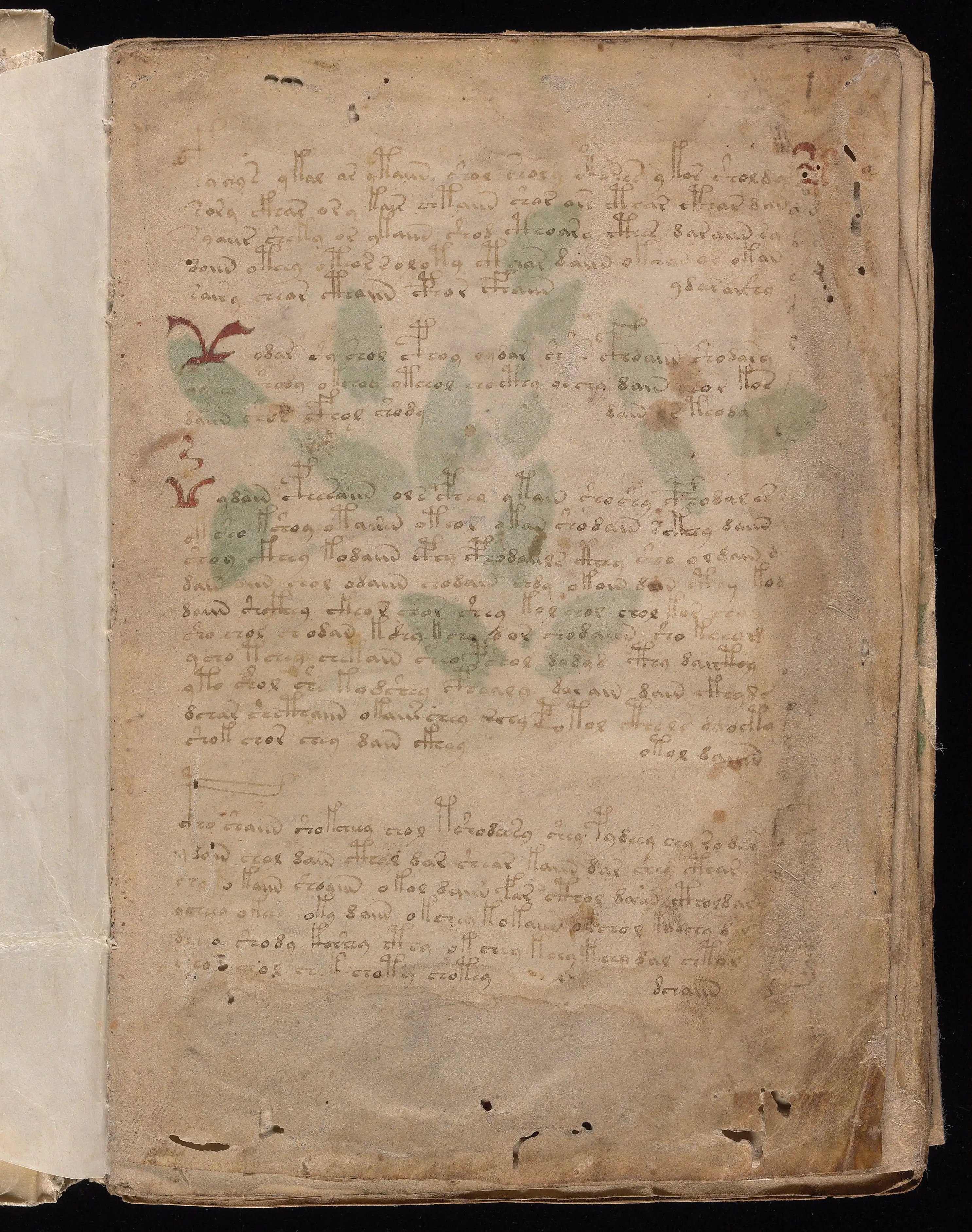
Illustration type Reiner Prosatext ohne Kräuterbild; Haskama-Typ: vier Absätze (P1–P4) mit rechtsbündigen Titeln (T1–T4) und roten Großinitialen &252/&253 (P2/P3)
Layout P1 umfasst Z.1–5 mit Titel T1 in Z.6. P2 umfasst Z.7–9 (rote Großinitiale &252) mit Titel T2 in Z.10. P3 umfasst Z.12–20 (rote Großinitiale &253) mit Titel T3 in Z.21. P4 umfasst Z.22–27 mit Titel T4 in Z.28. Jeder Absatz endet mit dem Kolophon-Marker '=' (R11). Am rechten Rand befindet sich der Erased Key (J-Transkription nach Reeds, 1994, in drei Spalten: A–Z, Voynich-Zeichen und eine versetzte dritte Spalte). Am Folioanfang ist die verblasste Jacobus-de-Tepenecz-Signatur erkennbar. Die grünen Wischmarken sind ein Farbdurchschlag vom gegenüberliegenden Folio und kein intentionales Bildelement.
Signals qo-: 0 Belege; 10/10 Sprache-A-Anker; 4 Absätze mit Titeln T1–T4; rote Großinitialen (Funktion offen); Erased Key (Jim Reeds, 1994); ★★★★ auf Strukturbefunden (R2-ext: 260 Token, Ankerverteilung, Absatzstruktur)
f1r analyzed Kein botanischer Bezug, deklarativer Prosatext 4★ 100%