Loading image …
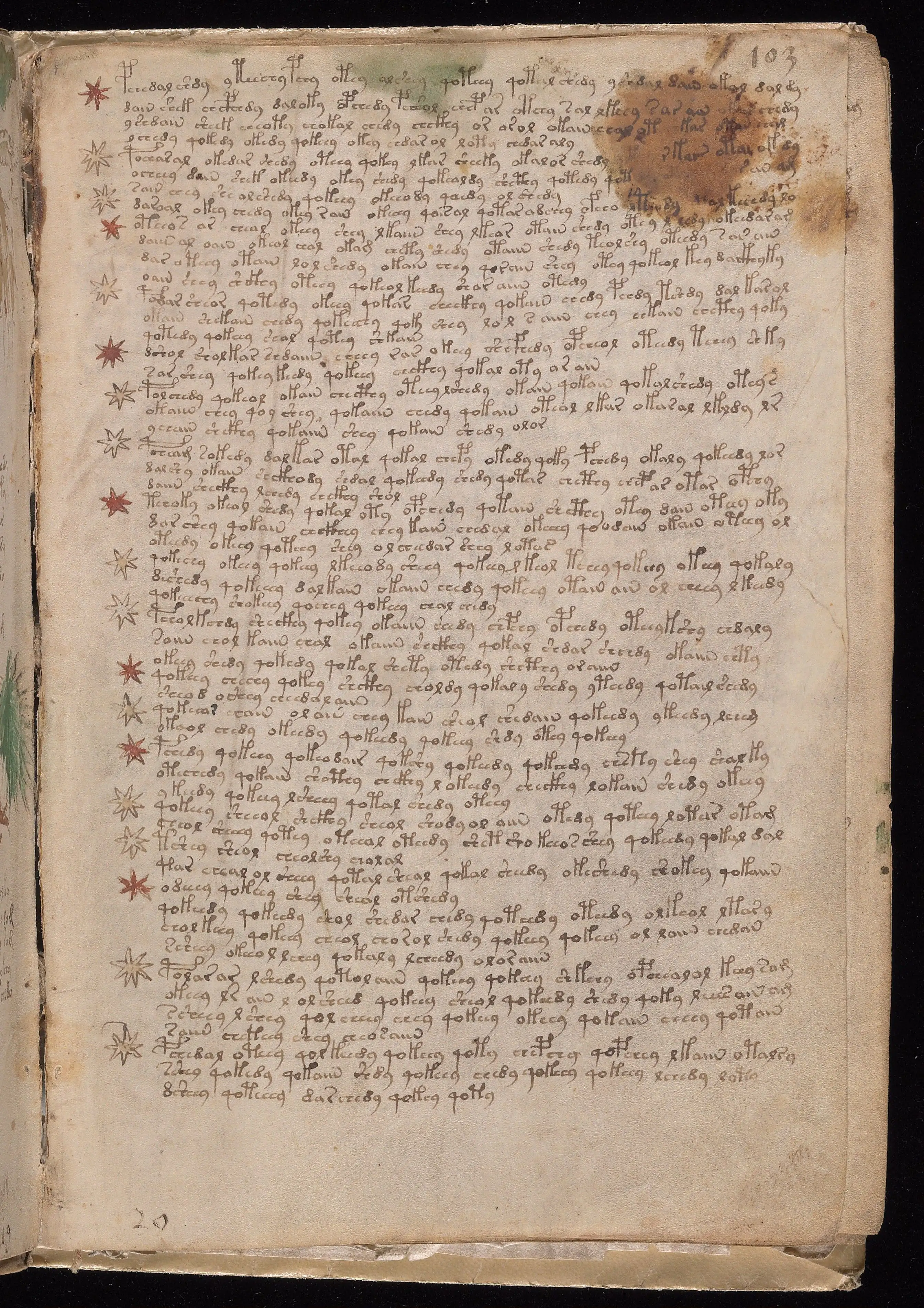
Base data
- Register type
- —
- Language class
- —
- Scribe hand
- —
Transcribers
- Sigla
- F · H P.1–P.54 (all paragraphs), n=2 — diverging: ylshy, tol, lky, chedaraly, otaiU P.1/P.2/P.3/P.4/P.5/P.6/P.7/P.8 (8 of 54) — diverging: alshy, dain, okal, chdar, olJ P.1/P.2/P.3/P.6 (4 of 54) — diverging: dain, rar, otar, qotootaI P.2 (1 of 54)G P.15 (1 of 54)
Rules
R1
qo- = וְ (Vav conjunctive) — ausschließlich Sprache B in Quires A+B 116 von 536 Token qo-initial (z. B. qoteey, qotal, qokody, qokeey)
R2 o-Positionsdetermination ^o: 122 Token (z. B. otey, opchedy, otchy); o wortintern: 187 Token (z. B. qoteey, qotal, daloky)
R4 t-initiale Wörter = Imperfekt 3. Sg. Fem. / 2. Sg. P.16: tchey (2/2); P.27: tchey (2/2)
R6 Zeilenabschluss-Prognose: sheol/shol = Tod; or = Heilung Todesprognose zeilenfinal: shol P.23=
R7 daiin am Zeilenanfang = Paragraphen-Öffner 3× daiin am Zeilenanfang (P.2, P.10, P.23)
R8 -aiin als Suffix = עַיִן (Auge) diagnostisch -aiin=עַיִן: 12× (z. B. kaiin, okaiin, qokaiin, oraiin)
R9 Refrain-Wörter — Anker-Position (≥3× pro Folio) daiin — 3× Anker (3 Öffner, 0 Kolophon), 4× gesamt; qokeey — 3× Anker (2 Öffner, 1 Kolophon), 26× gesamt
R11 Paragraphen-Ende mit = = Abschlussformel P.4: aly= (2/3); P.7: olshedy= (2/3); P.12: otedy= (1/2); P.15: shkain= (1/3); P.17: aiin= (1/2); P.20: olor= (1/2); P.23: shol= (2/2); P.26: lotos= (1/2); P.29: chedy= (1/2); P.32: oraiin= (1/2); P.34: cheedalaiin= (2/2); P.36: qokeey= (2/2); P.39: oteey= (1/2); P.42: chalal= (2/2); P.44: otshedy= (2/2); P.47: oloraiin= (2/2); P.51: cheosaiin= (2/2); P.54: qoty= (2/2)
R15 Paradigma-Wiederholungsreihen (×2–×5) P.1: qoteey·y·qoteey (Typ B); P.1: dy·dy (Typ A); P.2: sal·sal (Typ A); P.3: ot·kar·ot (Typ B); P.5: shedy·oteey·qokey·lkar·sheeky·okalor·shedy (Typ B); P.6: qot·qot (Typ A); P.7: olshedy·qokeey·okeeody·qoedy·olshedy (Typ B); P.8: okey·chedy·okey (Typ B); P.9: shey·lkaiin·shey (Typ B); P.10: shedy·otaiin·shedy (Typ B); P.18: okain·checthy·oteey·lshedy·okain (Typ B); P.26: shey·olcheedar·shey (Typ B); P.27: qokeey·lkeeody·sheey·qokeey (Typ B); P.31: okaiin·shckhy·qokal·shdar·shchdy·okaiin (Typ B); P.36: qokeey·shdy·otey·qokeey (Typ B); P.37: qokeedy·qokeedy (Typ A); P.45: qokeedy·qokeedy (Typ A); P.46: qokeey·cheol·chor·ol·shedy·qokeey (Typ B); P.46: ol·shedy·qokeey·qokeey·ol (Typ B); P.46: qokeey·qokeey (Typ A); P.48: qokeey·qokeey (Typ A); P.50: cheey·chey·qokeey·okeey·qokain·cheey (Typ B); P.53: qokeey·chedy·qokeey (Typ B); P.53: qokeey·qokeey (Typ A)
R17 shol (apokor.) medial vs. sheol (Vollform) am Zeilenende shol medial 4×, sheol medial 4×
R19 Intensivierungsrhetorik P.1: dy·dy (×2); P.2: sal·sal (×2); P.6: qot·qot (×2); P.37: qokeedy·qokeedy (×2); P.45: qokeedy·qokeedy (×2); P.46: qokeey·qokeey (×2); P.48: qokeey·qokeey (×2); P.53: qokeey·qokeey (×2)
R20 Direktionales Antonymenpaar lor ↔ lshol P.21: lor (2/2)
R37 R19-Intensivierungsschema für qo--Präfix-Wortgruppen ab Quire C P.27: qokchy (2/2); P.21: qoky (2/2); P.49: qoky (2/2); P.6: qotedy (4/4); P.13: qotedy (2/2); P.15: qotedy (3/3)
R40 Kurzwurzel-Konfidenzdeckel v2 P.17: sar (2/2); P.35: sheol (2/2); P.40: sheol (2/2); P.42: sheol (2/2); P.49: sheol (2/2); P.6: daiin (3/4); P.10: daiin (2/2); P.23: daiin (2/2); P.42: chalal (2/2); P.1: dal (3/4); P.13: dal (2/2); P.41: dal (2/2); P.3: or (3/4)
R41 Präfix-Hierarchie-Protokoll 20× korrekt geschichtete Präfixkette (qokody (qo-k-), okdy (o-k-), okeedy (o-k-), qokal (qo-k-) …); VERLETZUNG: P.26: lotos (l-o-, Grund a); P.38: lokeedy (l-o-k-, Grund a); P.38: lokain (l-o-, Grund a)
R50 Galiläische Guttural-Abschwächung — Sprache-B-Vokalklärung P.21: qokeedy (2/2); P.22: qokeedy (2/2); P.35: qokeedy (2/2); P.36: qokeedy (2/2); P.37: qokeedy (2/2); P.41: qokeedy (2/2); P.45: qokeedy (2/2); P.49: qokeedy (2/2); P.45: qoteedy (2/2)